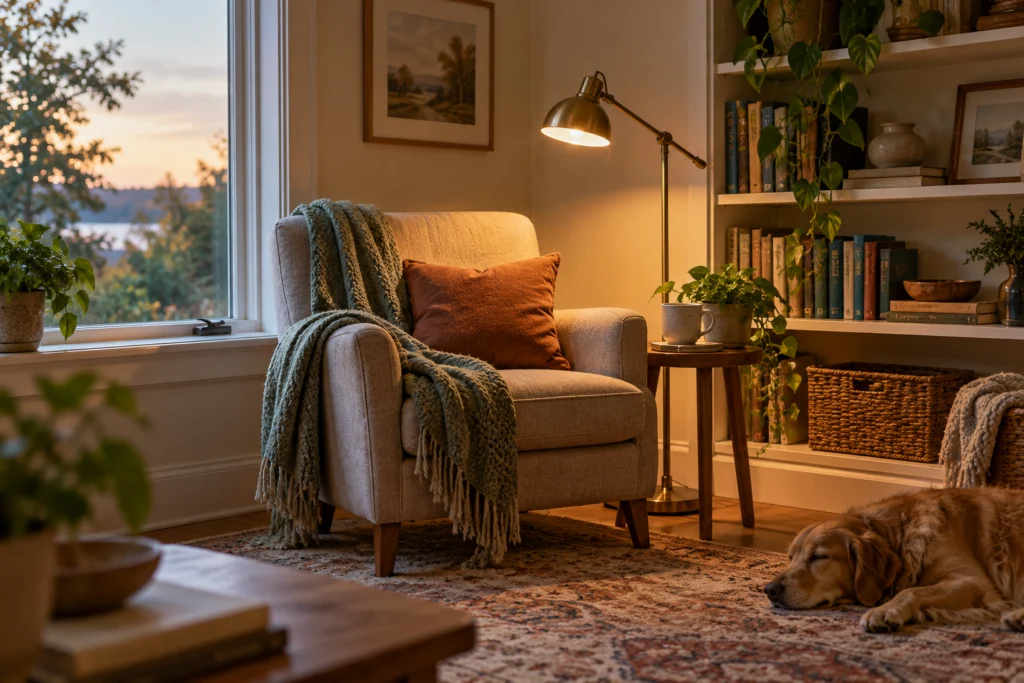
A quiet corner does not require a spare room or an expensive redesign. It needs a manageable location and a shared understanding of how it is used. The space can support reading, a pause or a quiet activity without being presented as a treatment for every difficult feeling.
Choose the purpose and location
Ask what people would use the corner for and when the home is busiest. A chair beside a lamp may work better than a decorative tent in the main walking route. Keep access to doors, services and other household needs clear.
Consider noise, light and supervision appropriate to the household. A child’s quiet space should not become an isolated place where adults assume no attention is needed. Use age-appropriate furniture and products according to their instructions.
| Element | Useful choice | Avoid |
|---|---|---|
| Seat | Comfortable stable furniture | An unsuitable improvised perch |
| Light | Enough for the chosen activity | A dark area with cables across the route |
| Storage | A few accessible books or materials | A new dumping zone |
| Agreement | How to request time and share the space | Using it as banishment |
Agree how people enter and leave
Make the space optional where practical and explain how others can respect it. A quiet corner is less helpful when every visit starts an argument about who deserves a break. Use simple turns or another clear sharing arrangement.
Do not require someone to emerge cheerful as proof the space worked. A pause can be useful without resolving the original issue. Necessary conversations and responsibilities can be revisited calmly afterwards.
- Start with existing furniture where suitable.
- Keep the location clear of essential routes.
- Choose a small amount of usable material.
- Explain that the space is for a pause, not punishment.
Review the ordinary practical details
Notice whether people actually use the corner and what interrupts them. A lamp switch out of reach or a noisy appliance may matter more than the colour scheme. Adjust one issue at a time.
If a family member is regularly withdrawing or struggling, do not assume a better corner resolves the concern. Seek appropriate professional guidance where difficulties persist or affect daily life.
Questions and answers
Does the corner need expensive sensory products?
No. Begin with the actual purpose and suitable ordinary items. Do not assume a product provides a clinical benefit.
Should it be used for time-outs?
Keep its agreed purpose clear. If it becomes a place of punishment, family members may no longer view it as a voluntary quiet space.
Can everyone use the same corner?
Possibly, with practical sharing arrangements. Different needs may require different times or a simple alternative.