
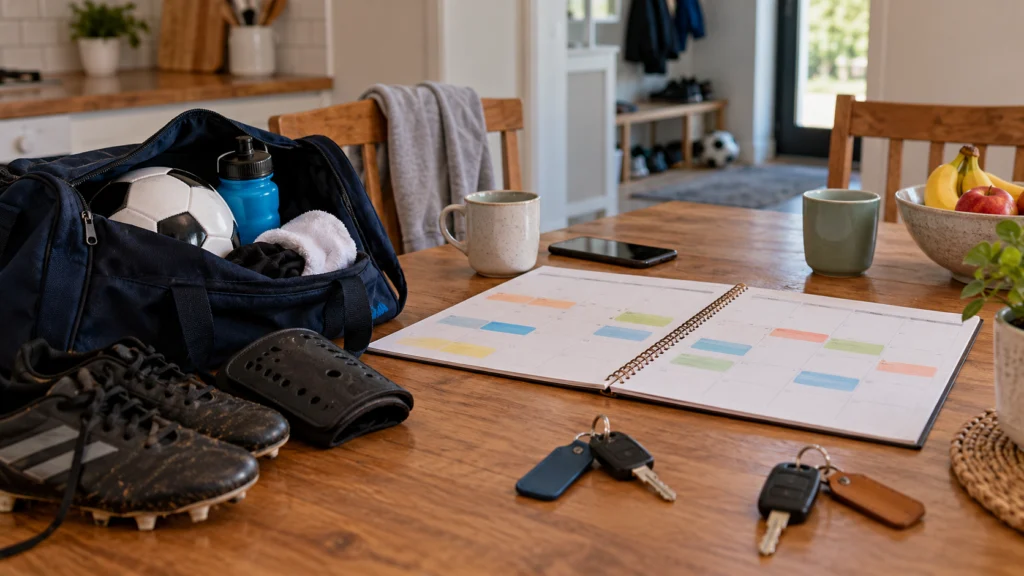
A child’s sports schedule can involve two households, a club and several changing messages. Clear logistics reduce the amount the child has to carry between adults. The plan should support participation without turning a training session into a test of which parent is more committed.
Use one reliable source for club information
Ask how schedules, cancellations and equipment notices are shared. Where the club’s process allows, each responsible adult should receive relevant information directly rather than relying on the child to relay it. Respect privacy and any applicable family arrangements.
Record transport and kit responsibility for each session. Include what happens if a person is delayed. A handover plan should be specific enough that the child is not left waiting while adults debate the original assumption.
| Item | Clarify | Avoid |
|---|---|---|
| Schedule | Current session and event information | Several conflicting calendars |
| Transport | Named adult and contingency | The child arranging adult changes |
| Equipment | Who holds and checks the kit | Blame over a missing item |
| Changes | Adult-to-adult update method | Messages sent through the child |
Separate logistics from disagreement
Keep messages brief and about the immediate task. A changed match time is not the moment to reopen unrelated disputes. If a decision affects money, travel or existing arrangements, discuss it through the appropriate adult process.
Do not ask the child to choose between households to solve an administrative problem. Their views matter, but responsibility for workable adult arrangements remains with adults.
- Confirm the week’s transport and equipment responsibility.
- Use direct club information where available.
- Agree an update method for delays and cancellations.
- Keep the child out of adult financial or relationship arguments.
Recognise when a simple calendar is not enough
Existing orders, agreements or safety concerns may affect what can be arranged. Obtain appropriate legal or professional advice rather than using a generic co-parenting article to override them. Joint conversations are not always suitable in situations involving fear or coercion.
After a few weeks, review the logistics that repeatedly fail. Change the practical system where possible instead of treating every forgotten item as evidence about the other adult’s character.
Questions and answers
Should the child carry messages between adults?
Avoid making them responsible for adult logistics or disputes. Use an appropriate direct communication method.
Can this guide decide who pays club fees?
No. That depends on the relevant arrangements and circumstances. Seek qualified advice for unresolved financial or legal questions.
What if direct contact is unsafe?
Prioritise safety and use the communication arrangements recommended by appropriate professionals or required by existing decisions. A shared app is not a universal solution.